
Fiber laser maintenance: a shorter daily list, and less room for error
A fiber laser asks less of the operator each morning than a plasma table does. The items that remain are the ones protecting the most expensive parts of the machine, including one that tells you it is failing before your cut quality drops.
A fiber laser asks less of your operator each morning than a plasma table does. That is genuinely true, and it is a function of the design: lasers carry extensive automatic greasing systems, and most bearing systems sit behind protective bellows.
A fiber laser runs at higher speeds, holds tighter precision requirements, and covers far more linear travel in a day than a plasma machine does, many more miles of motion. That combination makes it less forgiving of neglect, not more. The handful of items left on the daily list are the ones protecting the most expensive components on the machine.
As with any cutting machine, the daily inspection and the scheduled PM visit are two halves of one system rather than alternatives. Your operator catches what can be seen and heard. The technician catches what has to be measured.
This is the laser list. Plasma tables carry a longer daily routine and their own failure modes, covered separately in plasma cutting machine maintenance.
What needs checking on a fiber laser every morning?
Timing and ownership are the same as on any machine on the floor: the operator, in the morning, before the machine runs. Where several operators share a machine across shifts, the handover is exactly where this tends to fall apart, so it is worth being explicit about who owns it.
It is also worth being fair about why it gets skipped. Operators are focused on keeping output high, and that focus is the reason a five minute check can feel like a delay. The honest answer is that the check produces more output over a month than it costs in a morning, in the form of fewer surprises and fewer stopped shifts.
The short list
Because of the auto lube systems and the bellows over the bearings, the laser daily comes down to a handful of items:
- Listening for any sound that is not normal for that machine
- Confirming the grease reservoirs are not empty
- A visual check for components that look damaged, cracked or out of place
- Monitoring laser optic temperatures through the machine's diagnostic screens
That last one is worth building into the habit. The diagnostics will tell you the optics inside the head are running the way they should, and they will tell you before anything is visible in the parts coming off the table.
Alongside that, keep an eye on the same general wear items that apply to any machine with things that move: cable track links that have cracked or sprung open, hoses and cables that are fraying or chafing, gas leaks, and offcuts or debris left sitting where something moves. None of it is laser specific, and all of it follows the same pattern, where a part worth a few dollars takes out something worth a great deal more if it is left alone.
The lower protective window
This is the single most valuable item on the list.
Every lens in the head is sealed except one. The lower protective window is the only optical component the operator changes, it is designed for field changes, and its entire job is to be sacrificed so the expensive optics behind it are not.
Check it daily, before the shift starts, and confirm there is no contamination on it.
What makes this item unusual is that it announces its own decline. As the window wears or builds up a film, its temperature begins to rise, and that shows up in the laser's diagnostic section. It can also present as reduced cut quality or reduced cut speeds, but the temperature moves first. Reading optic temperatures off the diagnostics each morning is a concrete habit that gives you warning before the parts tell you.
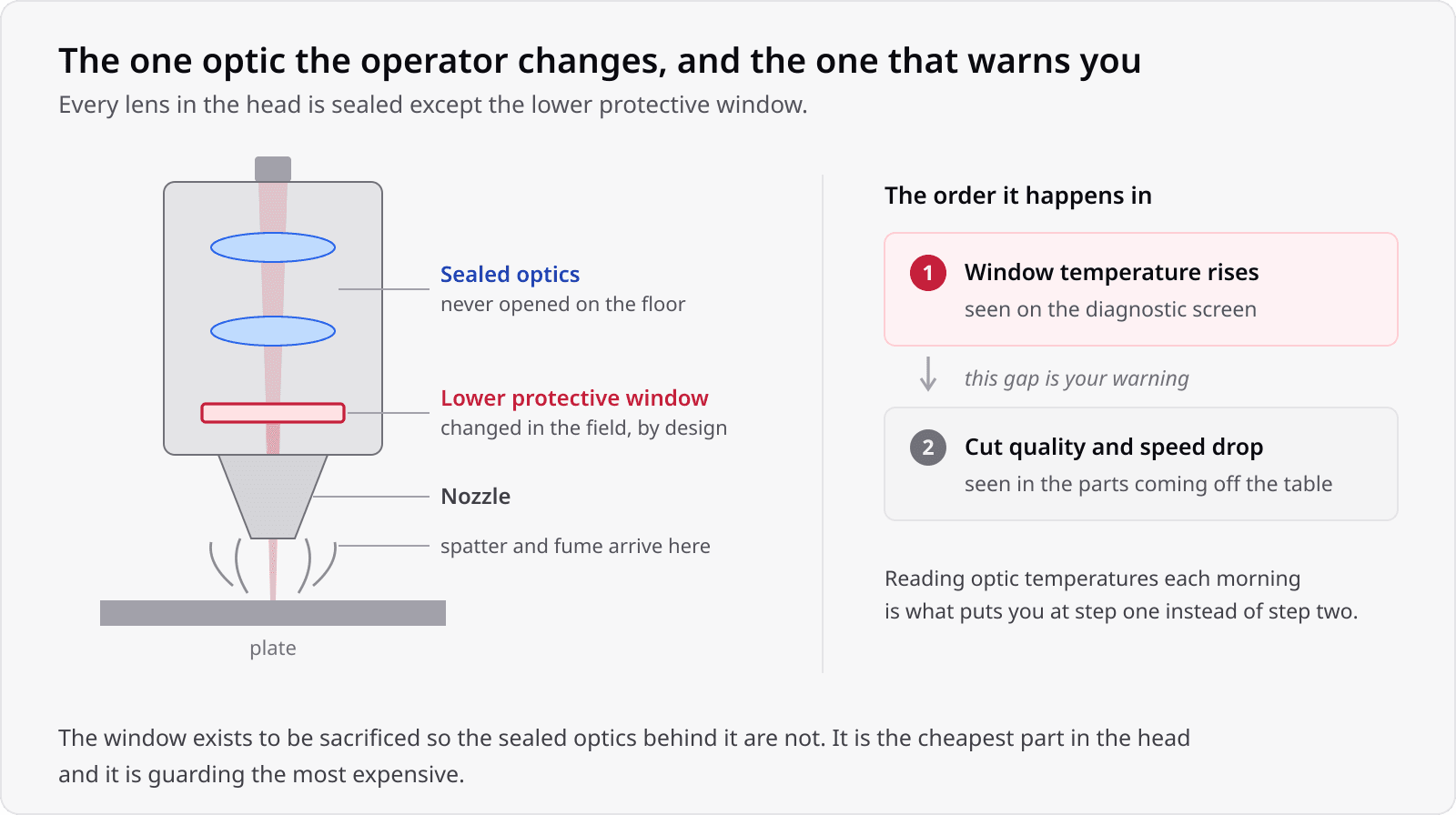
The cheapest part in the head, sitting in front of the most expensive ones. Everything above it is sealed.
Nozzle and beam centering
Nozzle condition should be checked daily.
Beam centering procedures are designed for the operator to perform and are worth doing on a regular basis. Between the two, this is what holds the machine at maximum performance rather than letting it drift slowly into merely acceptable.
Chiller
The chiller will notify the operator when coolant is getting low. Keep distilled water on hand so the reservoir can be topped up when the system asks for it.
Chiller coolant changes at the recommended intervals are handled by the PM team, so that is not something your operator needs to take on.
Do not open the laser head
Operators should not open laser heads. The contamination risk is simply too high.
When the sealed components of the head need attention, AC Machinery's service technicians have the appropriate tools and clean boxes to do that work properly. With regular daily maintenance and scheduled PM visits, the expensive components inside the head can last many years in heavy operation.
Consumables and gas
Use genuine manufacturer supplied components. They have been through quality control testing to deliver the cut quality the machine was designed for, and AC Machinery stocks them.
Gas quality, air quality included, feeds directly into both machine performance and consumable life. Check the pressures going into the machine daily and confirm they are at the recommended values. Marking the specified pressure on each regulator is a small habit that converts a measurement into a glance.
The gas feed system filters are checked for contamination by the technician at PM visits.
After a crash
If there is a crash or collision, have the operator do a quick visual check to confirm nothing was damaged. Collision detection and avoidance systems on these machines are sophisticated and will usually prevent damage, but in a production environment the visual check costs a minute and is worth doing.
Does an automatic greasing system still need attention?
Yes. Lasers typically have automatic greasing systems, and automatic does not mean unattended.
The specification still matters
The grease grade is the same as it is anywhere else on a moving cutting machine: NLGI #2, with no extreme pressure or anti wear additives and no molybdenum, because those additives build up inside bearing systems.
If you are ever unsure what is in a cartridge, colour will tell you most of what you need. Black grease is the wrong grease, every time, because black indicates the high pressure additive package that belongs on heavy load bearing surfaces rather than in linear bearings. Correct product is usually amber, sometimes blue or red. The colour is the quick check, the additive package is the real answer.
It does not need to be an expensive product. Choose one good quality NLGI #2 that is easy to get hold of, and stay with it across your equipment rather than switching between whatever is on the shelf.
What to actually check on an auto lube system
Three things, and the third is the one people miss.
Confirm the reservoir feeding the auto pump has grease in it. The system will notify the operator when it runs empty, and that notification needs to be acted on rather than noted. Keep a spare reservoir in stock, since they are inexpensive and quick to change.
Then inspect the grease lines for leaks. This is the failure mode worth understanding properly, because of how quietly it happens. The system pumps for a preset duration on the assumption that pressure is building and grease is reaching every bearing. If a line is damaged, the grease escapes at the break, the bearings downstream of it receive nothing, and the system still reports a normal cycle. The machine tells you it lubricated itself while bearings run dry.
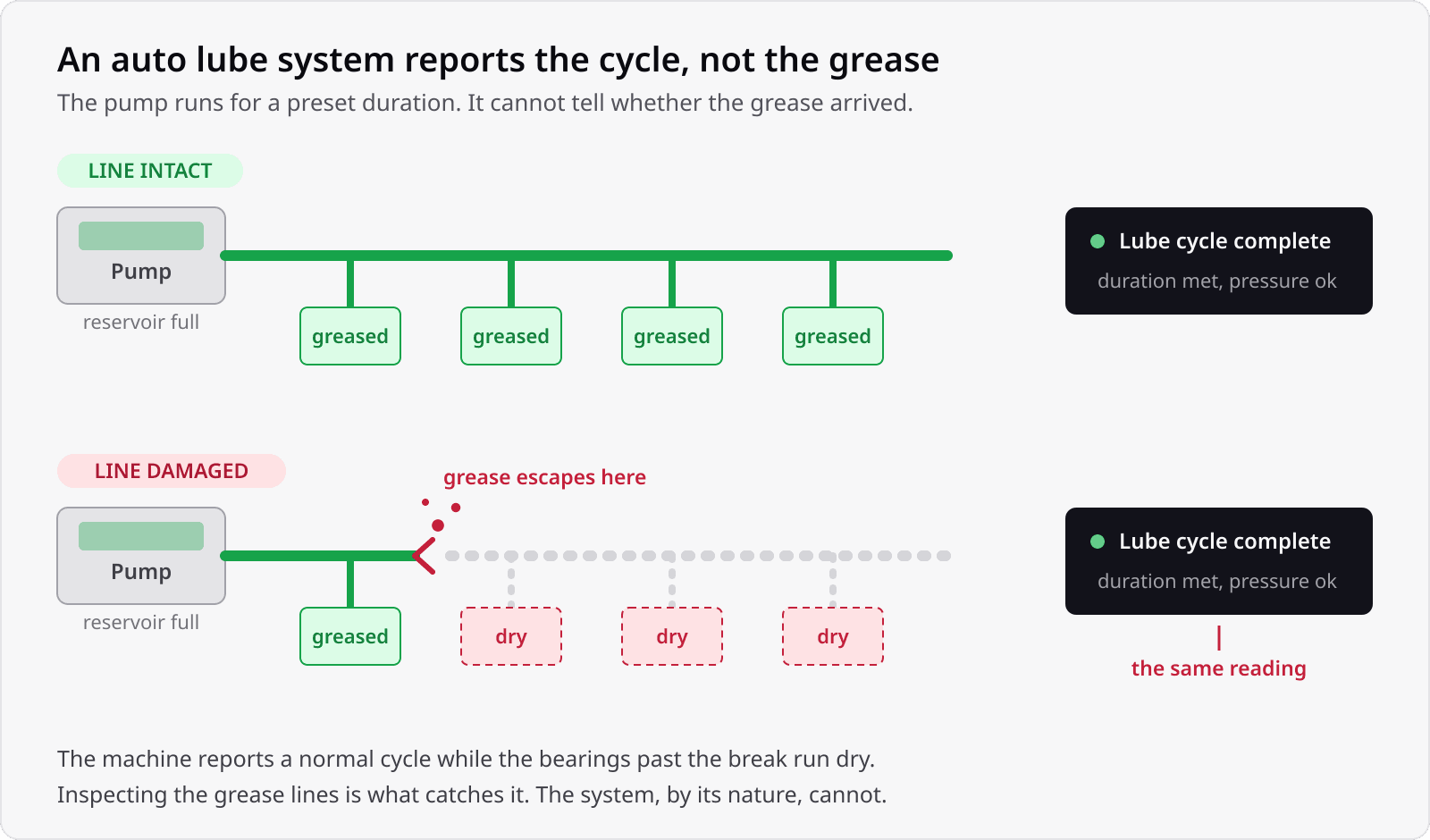
The reading is the same in both cases. The pump measures how long it ran, not where the grease went.
That is precisely the kind of failure a daily visual catches and an automated system, by its nature, cannot.
What it buys you
Bearings last substantially longer, motion stays smooth, and vibration stays low. Vibration is the thing worth caring about, because it wears everything else in the drive system ahead of schedule. The payoff shows up in the parts coming off the machine and in the life of the machine as a whole, not only in the bearings themselves.
How often does a fiber laser need preventive maintenance?
Two PM visits per year, per shift.
Where operators do their dailies and PM lands on interval, components that might otherwise need replacing inside a year can run for many years of three shift operation.
That is a higher interval than we recommend for plasma, and the reason is the duty the machine is under. Higher speeds, tighter precision requirements, and considerably more linear travel per day all accumulate. Two visits per shift per year is what delivers maximum performance and longevity while keeping total lifetime maintenance cost down.
It sits alongside the daily inspections rather than replacing them, and it is the work a preventive maintenance program covers.
What a technician brings that an operator cannot
Electrical work heads the list, and that is a safety boundary rather than a preference. The electrical and arc flash certification required to work on or measure electrical components is not something most operators or plant staff hold, so that work belongs with trained technicians.
The rest is a mix of measurement and access: backlash measurement, pump flow readings, servicing the sealed components of the head with proper tools and clean boxes, gas feed filter inspection, chiller coolant service, and an assessment of component degradation that is not visible from outside the machine. Much of the value of a visit is time spent looking for problems that have started but have not yet surfaced.
What you receive afterwards
Each visit produces a written report: what was checked, the backlash measurements, any adjustments made, and flow and temperature readings.
Keep the backlash numbers. Across several visits they become a record of how your specific machine is changing, which is a different thing from a service receipt. You end up owning trend data on your own equipment.
Component recommendations in the report are separated into what needs replacing now or within the next few months, what is worth holding in stock, and what to expect over longer intervals. That separation exists so maintenance can be forecast and budgeted rather than arriving unannounced.
Backups and warranty
AC Machinery can set up full hard drive backup systems and supply the drives, which makes parameter restoration quick if it is ever needed.
Also worth keeping in view: many warranties are conditional on regular maintenance being carried out. Following the manufacturer's recommendations protects the warranty position alongside the machine.
Can someone else track the PM intervals for you?
If you would rather not track intervals yourself, AC Machinery can place you on a managed maintenance schedule. Our maintenance department contacts you to book each visit at the interval your production volume calls for.
AC Machinery works to keep this affordable on purpose. Our technicians are local to Canada, so there is no cost of flying people in from other countries, and PM that is affordable is PM that actually gets booked. That is what turns into reliability on the floor.
Common wear items live at AC Machinery's Cambridge, Ontario facility and travel in the technicians' vehicles, pumps, bearings and gears among them, so in most cases something found during a visit can be dealt with on the same visit instead of waiting for a return trip.
To be placed on an AC Machinery managed maintenance schedule, get in touch and we will set the interval to your production volume. We can also prepare a daily inspection checklist built around your machine and your shop, or walk you through hard drive backup options.
About Adam Bender
Adam spent roughly twenty years as a field technician servicing plasma and laser cutting machines before taking over AC Machinery. These notes come from that work.
Adam Bender on LinkedInFAQ
Common questions
Short answers to the questions we are asked most about this topic.
The lower protective window for contamination, the grease reservoir level, laser optic temperatures on the diagnostic screen, nozzle condition, and a visual and listening check for anything damaged, out of place, or making a sound that is not normal for the machine.
It is the only optical component in the head the operator changes, and it exists to protect the far more expensive sealed optics behind it. As it builds contamination its temperature rises, which shows up in the machine's diagnostics, often before there is any visible drop in cut quality or speed.
Yes. Confirm the reservoir is not empty, keep a spare on hand, and inspect the grease lines for leaks. An auto lube system pumps for a preset duration assuming grease is reaching every bearing, so a damaged line lets grease escape at the break while the system still reports a normal cycle and the bearings downstream get nothing.
Two PM visits per year, per shift. That is a higher interval than a plasma machine, deliberately, because lasers run at higher speeds, hold tighter precision requirements, and accumulate far more linear travel per day.
No. The contamination risk is too high. Service technicians have the proper tools and clean boxes to work on the sealed components of the head when that work is needed.