
Plasma cutting machine maintenance: what actually causes the service call
Most plasma service calls trace back to three preventable things. Here is what to check every morning, which grease to use, and the one part you should never grease at all.
Industrial cutting equipment is built to run for years in hard conditions. It is designed so that the parts most likely to fail first are small and inexpensive, what a technician would call the fusible links of the machine. Caught early, those are a few dollars and a few minutes. Ignored, they cascade into failures that cost thousands, take the machine out of production, and turn into a service call.
After roughly twenty years of service calls on plasma cutting machines, the overwhelming majority trace back to three preventable causes:
- Daily inspections not being performed
- Greasing not done, or done with the wrong grease
- Scheduled preventive maintenance not being booked
Daily inspections and scheduled PM are not competing options. They are two halves of the same system. The operator catches what can be seen and heard. The technician catches what has to be measured.
This is the plasma list. A fiber laser carries a shorter daily routine and a different set of failure modes, covered separately in fiber laser maintenance.
What should be checked on a plasma machine every day?
A thorough visual walk around the machine, looking for anything out of place, worn, damaged, or where it should not be. The operator performs it in the morning, before running the machine, as part of the start of shift routine. In a multi shift operation, where several people share one machine, it matters more, not less.
Operators have good intentions and are focused on keeping output high. That focus is exactly why the morning inspection sometimes gets skipped. It is worth saying plainly to both operators and management that a few minutes of inspection and greasing produces higher total output over time. Short inspections up front deliver what management actually wants, which is more parts out the door and fewer surprises.
What to look for:
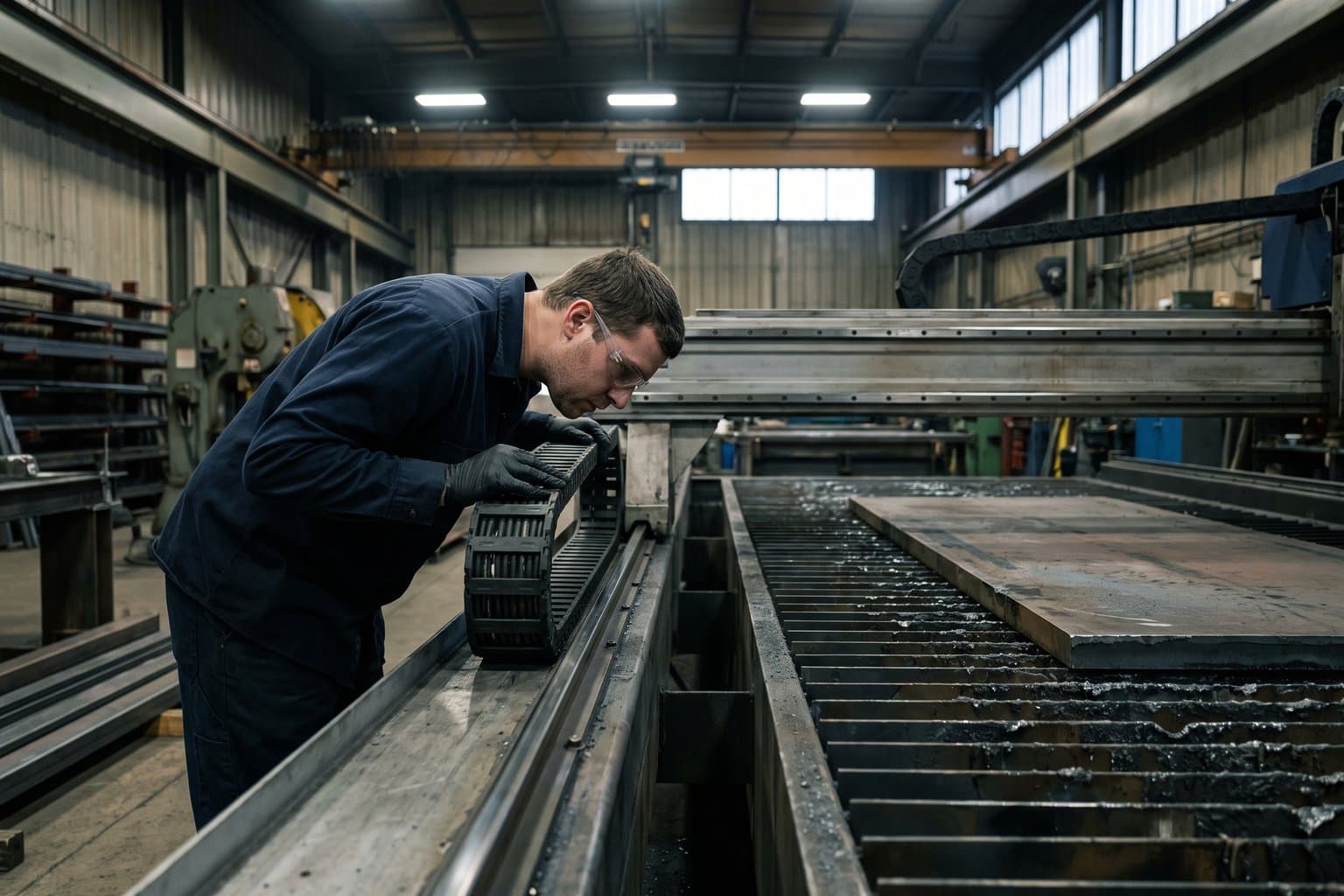
- Cable track: cracked or broken links, sections sprung open, damage from items dropped on the track or the track being bumped
- Hoses and cables: fraying, cracking, chafing, kinks, signs of rubbing wear
- Gas leaks anywhere in the system
- Parts, offcuts and debris left sitting on the machine, particularly on or near anything that moves
- Debris and contamination building up on bearing surfaces or near drive systems
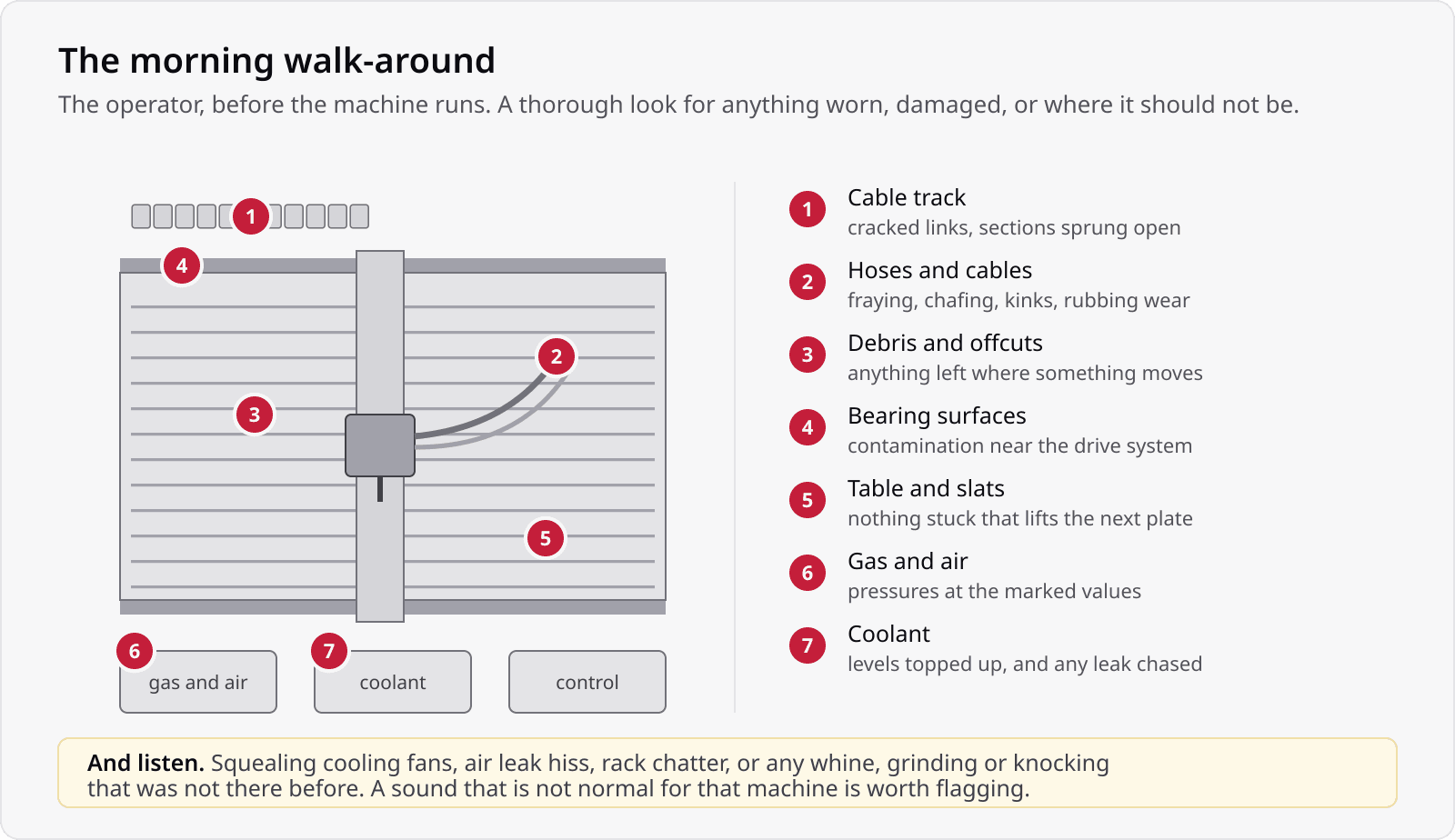
The same list, laid out as a route around the machine. Print it and put it beside the control station if that helps it get done.
Why the small things matter
A cracked cable track link may cost a few dollars to replace. Left in place, the wear spreads. Adjacent links fail, the track sags or springs open, and the cables and hoses it was protecting get pulled, chafed or severed. What began as a few dollar part becomes broken cables, electrical shorts and ripped hoses. That is the whole argument in one example: a few dollars caught on a Monday morning, against several thousand and a week of downtime later.
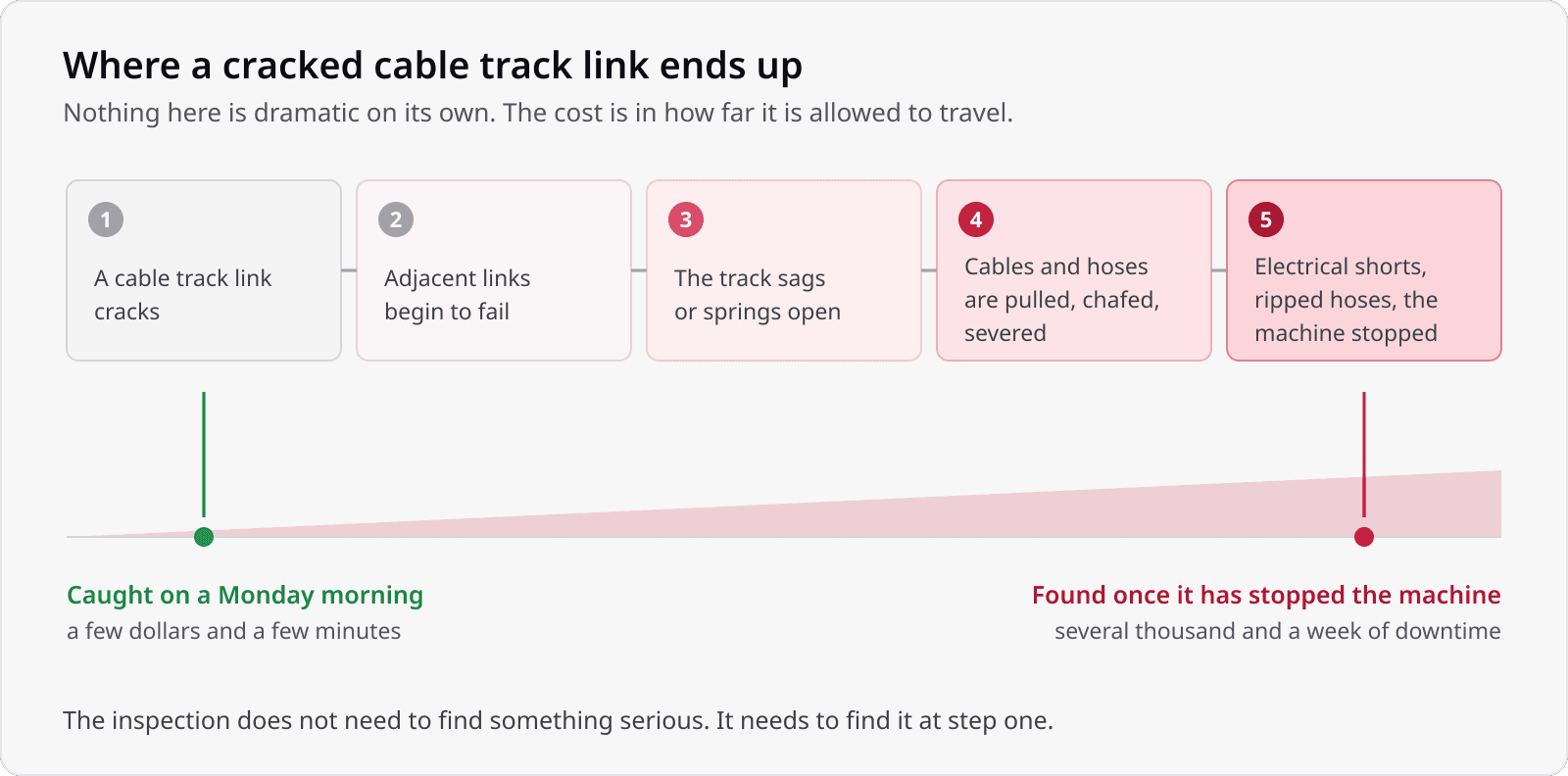
No single step here is dramatic. The cost is in how far it is allowed to travel before somebody looks.
Listening, not just looking
Operators should be listening as well as looking. Any sound that is not normal for that machine is worth flagging.
Squealing cooling fans on the coolant system radiators are the clearest example. These fans begin to squeal as they age, and they are designed to be easy to replace, so catching the noise makes it a quick and cheap fix. A worn fan also draws more power, which raises the risk of blown or shorted fuses, and replacing it keeps the coolant system running cooler. The cooler a machine runs, the longer it lasts, and that matters most under continuous duty cycle operation.
Also listen for air leak hiss, rack chatter, and any whine, grinding or knocking that was not there before.
Coolant
Check coolant levels daily and top up with the appropriate coolant. These are closed loop systems, so they should not need much topping up. A system that is repeatedly low is telling you there is a leak worth investigating.
Radiator fins do not need daily inspection, and coolant flushes and changes are handled by the PM team rather than the operator.
Table and slats
Plasma's wider cutting kerf deposits extra slag and molten steel on the slats. As slats fill up, material stops sitting flat on the table, and that affects cut perpendicularity and overall cut quality. Slats are designed to last many shifts, so this is about buildup rather than replacement. From the operator's side, the daily check is simply making sure no cut parts are stuck to the slats in a way that would leave the next sheet sitting out of level.
Gas and air supply
Gas quality, including air quality, is a real factor in both machine performance and consumable life. Check the pressures feeding the machine daily and confirm they are at the recommended values.
One practical tip that costs nothing: mark the regulators with the specified pressures. That turns a measurement into a visual check, and the operator can see at a glance whether a regulator has drifted.
Gas feed system filters are checked for contamination by the technician during PM visits.
Consumables
Use genuine manufacturer supplied components: electrodes, nozzles, swirl rings and shields. These have gone through quality control testing to deliver the cut quality the machine was built for. AC Machinery stocks all of them.
After a crash
If there is a crash or collision, do a quick visual inspection to confirm nothing was damaged. Most machines have collision detection and avoidance systems that prevent damage, but in a production environment a quick visual check is always worthwhile.
What grease should a plasma cutting machine use?
Getting the grease right
NLGI #2 is the correct grade for linear bearings and effectively every greasing point on a moving cutting machine.
It should carry no extreme pressure or anti wear additives, and no molybdenum. Those additives build up inside bearing systems.
The simplest field test is colour. If it is black, it is the wrong grease. Black greases carry high pressure additives and belong on heavy load bearing surfaces, not in linear bearings. The correct grease is typically amber, sometimes blue or red. Colour is a useful indicator, but the deciding factor is the additive package.
This does not have to be an expensive product. Pick a readily available, good quality NLGI #2 and use that same product consistently across the equipment.
Doing it properly
Follow the manufacturer's recommended intervals, and make sure it actually happens on schedule. Give operators grease guns and a defined schedule to work to. Wipe excess grease off the bearing ways afterwards.
Consistent greasing buys substantially longer bearing life, smoother motion, and less vibration. Vibration is what prematurely wears everything else in the drive system, so the benefit reaches well past the bearings themselves and shows up in cut quality and in the life of the machine as a whole. For the effort involved, greasing has the best return of anything on the machine.
Should you grease the exposed gear rack?
No. Do not grease exposed gear rack. Blow it off clean. This one is worth stating on its own, because it runs against the instinct.
Inspect the rack for damaged teeth as part of the routine. If a tooth is damaged, report it to the manufacturer or the plant maintenance department immediately.
The reason it is urgent: a single damaged rack tooth will damage the pinion gear. That damaged gear then travels the full length of the rack, striking many points along the way and spreading the damage as it goes. One small broken tooth, left alone, can damage an entire length of gear rack.
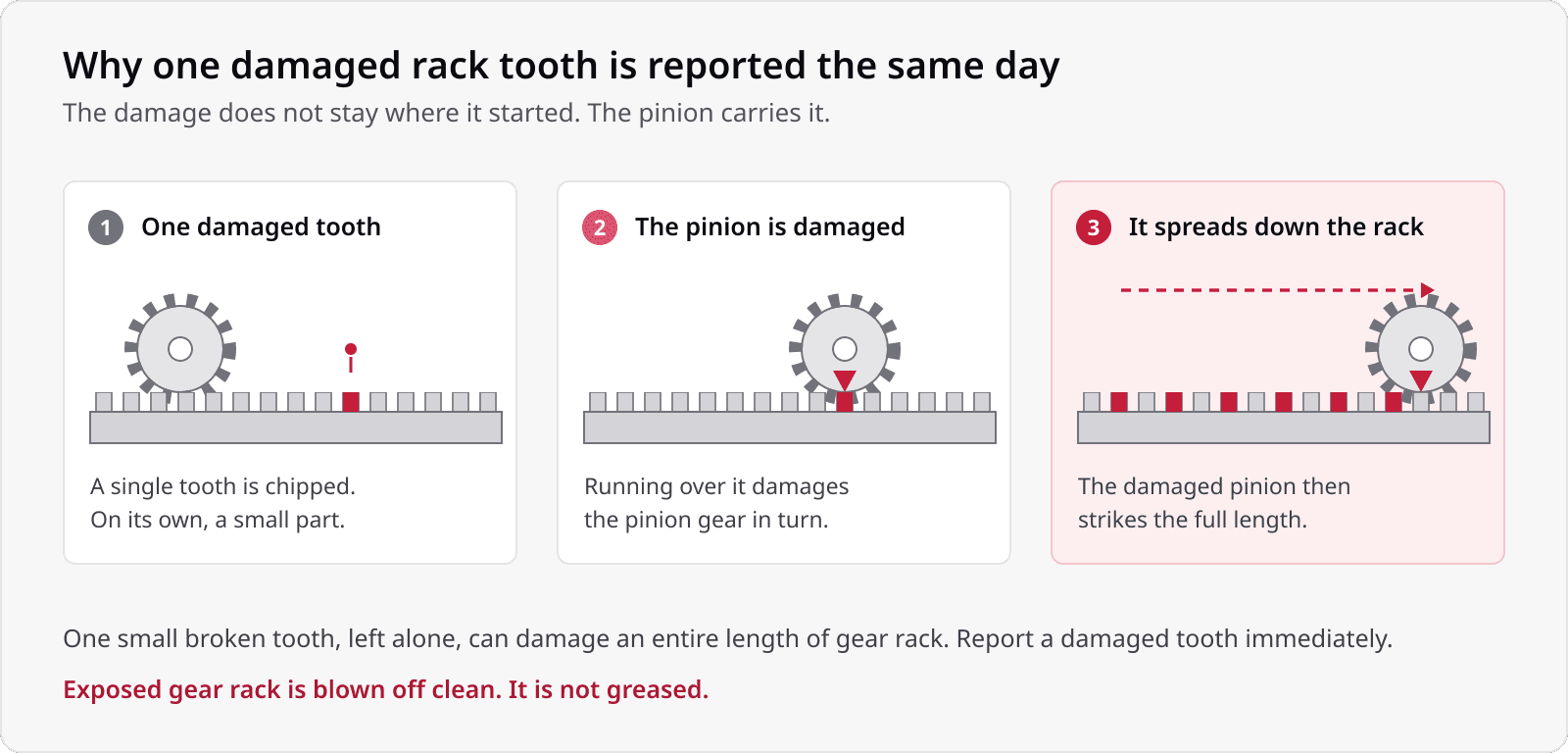
The damage does not stay where it started, which is why a chipped tooth is a same day report rather than something to mention at the next visit.
How often does a plasma machine need preventive maintenance?
- Machines receiving daily inspections: one PM visit per year, per shift. A two shift operation gets twice as many visits as a single shift operation.
- Dirty environments, shops requiring the highest possible performance, or shops with no backup processing capability: two visits per year, per shift.
When operators do their dailies and PM is scheduled on interval, components that would otherwise need replacing within a year can last many years of three shift operation.
This is in addition to daily inspections and operator greasing, not a replacement for them. It is the work covered by a preventive maintenance program.
What a technician does that an operator cannot
Electrical measurements come first, and this is a safety issue rather than a preference. Most operators and plant staff do not hold the electrical and arc flash certification required to work on or take measurements from electrical components, so that work has to be left to trained technicians.
Beyond that: backlash measurement, pump flow readings, torch height control and ohmic sensing testing, gas feed filter inspection, coolant service, and the assessment of component wear that simply is not visible from the outside. A good part of a PM visit is digging into the machine to find developing problems before they become failures.
The written report
Every PM visit produces a written report covering everything that was checked, the backlash measurements, any adjustments made, and flow and temperature readings.
The backlash figures matter more than they first appear. Recorded visit over visit, they let you track change over time on your own machine, so you are not buying a service call so much as building a record of how that machine is ageing.
The report also splits component recommendations three ways: items needing replacement now or within the next several months, items worth carrying in stock, and items expected to need replacement over longer intervals. The point of that split is budgeting. It lets you plan maintenance expense instead of being surprised by it.
Backups and warranty
AC Machinery offers full hard drive backup systems, and can supply the backup drives themselves. It is inexpensive peace of mind, and it means parameters can be restored quickly if they are ever lost.
It is also worth remembering that many warranties require regular maintenance to remain valid. Following the manufacturer's recommendations protects your warranty position as well as the machine.
How do you get on a maintenance schedule?
Customers who want regular PM can be placed on an AC Machinery managed maintenance schedule. Our maintenance department reaches out to book the visit at the right interval for your production volume, so nobody has to remember to call.
AC Machinery keeps this work affordable deliberately. Our technicians are local to Canada, which avoids the heavy travel expense of flying people in from other countries, and affordable PM is PM that actually gets scheduled. That is what improves reliability in practice.
Common wear items are stocked at AC Machinery's Cambridge, Ontario facility and carried in the technicians' vehicles, including pumps, bearings, gears, torch heads, torch receptacles, torch leads, fans and relays. In most cases that means a finding can be corrected on the same visit rather than waiting for a return trip.
If you would like to be placed on an AC Machinery managed maintenance schedule, get in touch and we will set the interval to your production volume. We can also put together a daily inspection checklist customized to your machine and your shop, or talk you through hard drive backup options.
About Adam Bender
Adam spent roughly twenty years as a field technician servicing plasma and laser cutting machines before taking over AC Machinery. These notes come from that work.
Adam Bender on LinkedInFAQ
Common questions
Short answers to the questions we are asked most about this topic.
Three preventable things account for the overwhelming majority: daily inspections not being performed, greasing not done or done with the wrong grease, and scheduled preventive maintenance not being booked.
NLGI #2 is the correct grade for linear bearings and effectively every greasing point on a moving cutting machine. It must have no extreme pressure or anti wear additives and no molybdenum, because those build up inside bearing systems. The simplest field test is colour: if the grease is black, it is the wrong grease.
No. Exposed gear rack should be blown off clean, never greased. Inspect it for damaged teeth as part of the routine, and report any damaged tooth immediately, because a single damaged tooth will damage the pinion gear, which then spreads that damage along the full length of the rack.
For a machine that receives daily inspections, one PM visit per year per shift. A two shift operation gets twice as many visits as a single shift operation. Dirty environments, shops needing the highest possible performance, and shops with no backup processing capability should move to two visits per year per shift.
The machine operator, in the morning, before running the machine. It is part of the start of shift responsibility, and it matters even more in multi shift operations where several operators share one machine.