How do you size a nitrogen generator for laser cutting?
You size it to your shop's real production, not to a worst case. There is no standard size for a given laser power or thickness.
You size it to your shop's real production, not to a worst case. That means working out how much nitrogen your lasers actually use across a light, a typical and a heavy day, shift by shift, for a full week, and then choosing the generator output, the high-pressure storage and the production schedule together so the system carries that week. There is no standard size for a given laser power or thickness. Two shops with the same laser can need very different systems, because one may cut primarily sheet metal and the other runs a range of materials and thicknesses.
What a nitrogen generator does, and who benefits
A nitrogen generator makes nitrogen from compressed air, in real time, in your own shop. It replaces nitrogen bought from a gas supplier, either as cylinder packs or as bulk liquid, and making nitrogen costs substantially less than buying it.
In many cases a shop running a fiber laser can benefit from a generator on as little as one shift a day, depending on its production. The more the shop cuts on nitrogen, the larger the saving, because the main system cost is fixed and the savings grow with every hour of cutting.
Why sizing is the hard part
Generators get expensive quickly when they are not sized correctly, and an oversized system can push the payback out of reach. Sizing one correctly takes data and experience: how lasers use nitrogen at each power and thickness, how shops actually run them, which generator and storage options exist, and how your own production moves through the week.
That is where AC Machinery's background matters. We have been selling fiber lasers for more than 12 years. We have experience with systems from 2 kW to 60 kW. Our applications engineers have built laser cutting databases (the cut parameters) for multiple wattages, and they have hands-on experience with laser operation, assist gas flows and nozzle selection. We have also metered nitrogen flow on fiber lasers cutting in real production, rather than relying on published cut charts alone. A company that sells only nitrogen generators does not have that knowledge, and neither does a machine seller that has not developed its own cutting databases or taken real world measurements.
Where the usual sizing goes wrong
Many generators are sold on a worst-case number: every laser cutting the heaviest plate on nitrogen on every shift. That number substantially exaggerates the delivered gas bill which in turn makes the ROI look better for an expensive and oversized nitrogen generator. In these situations the conversation intentionally stays on payback while discussions about the unusually high nitrogen usage or the capital cost of the system are avoided. Another unfortunate scenario occurs when nitrogen usage is averaged based on a customer's purchase volume over a given time period. An average usage does not properly account for demand peaks resulting in an undersized system and wasted capital dollars.
The result is one of three outcomes. The shop buys more system than it needs, buys an undersized system or it walks away from the quote and keeps paying for delivered gas. Starting from real usage also means we can tell you up front when a generator will not pay back for your shop.
What we ask you before sizing anything
- The materials you cut, and their thicknesses
- How many lasers you run, and the power of each in kW
- The brand of lasers you are using
- Whether you currently mark/scribe with your lasers
- Operating efficiency: how much of each shift the beam is actually cutting
- Shifts per day, hours per shift and when the first shift starts
If you are planning growth, such as another laser, we build it in from the start.
This info can get us really close. From there we work with you on production scenarios so you can see the effects.
How we turn that into a system
Our N2 Flow Bench turns your production into nitrogen use and tests candidate nitrogen generator systems against your light, typical and heavy days, with each shift set separately for every day of the week. The consumption behind it comes from the manufacturers' cut charts and from our own flow measurements on lasers cutting in production.
Then we adjust three things with you until the system fits:
| Lever | What it changes |
|---|---|
| Generator output | How much nitrogen is made per hour: a larger or a smaller generator |
| High-pressure storage | Adding or removing storage packs, so stored gas carries the peaks while the generator catches up |
| Production schedule | Moving heavy plate to another shift or day so storage refills in between. This can be the trade a shop makes instead of buying a bigger generator |
Sometimes the right answer is a bigger or smaller generator. Other times it is more or less storage. Because every shift on every day can be changed, you see the trade-offs and take part in choosing the system.
The report we walk customers through shows each day as a chart of stored gas over 24 hours, then the full week. Two results matter, and they are not the same. A system can carry today's shift on stored gas and still make less nitrogen in 24 hours than the day uses, so the storage starts each day lower than the last. The harder failure is when the storage runs empty mid-shift and the laser waits for gas. A pack that empties on a heavy day is not automatically the wrong system; what matters is whether it refills before the next heavy day.
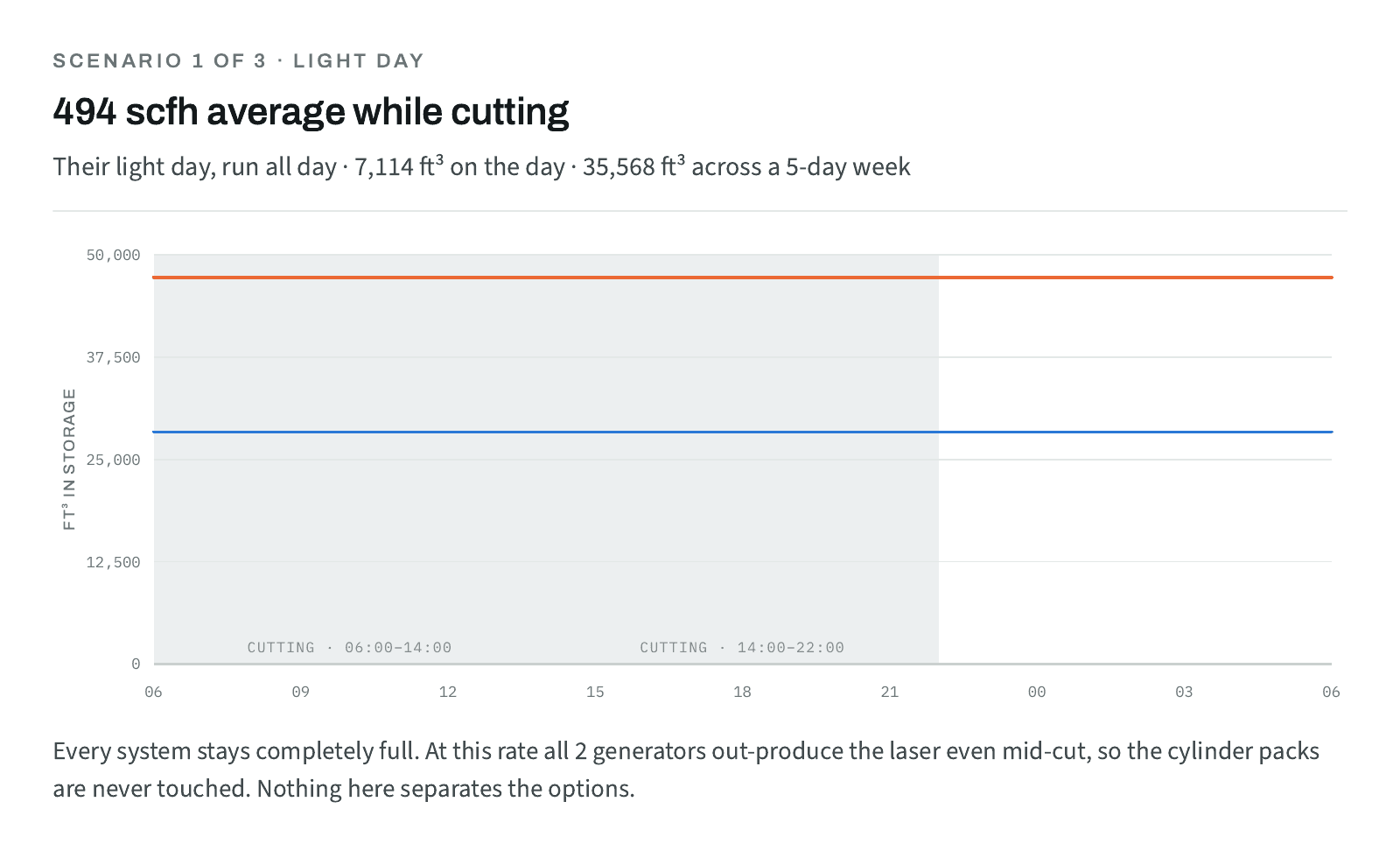
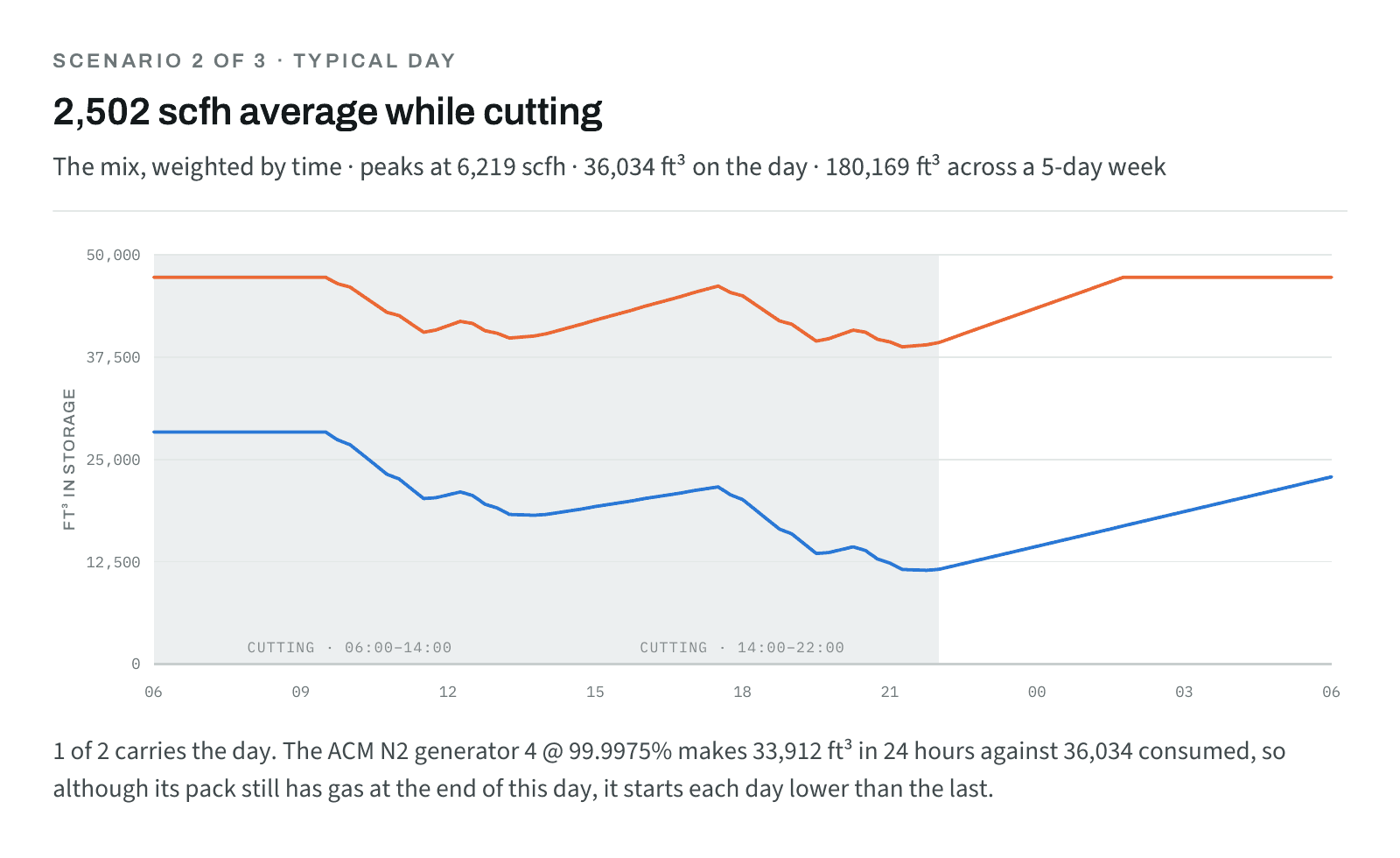
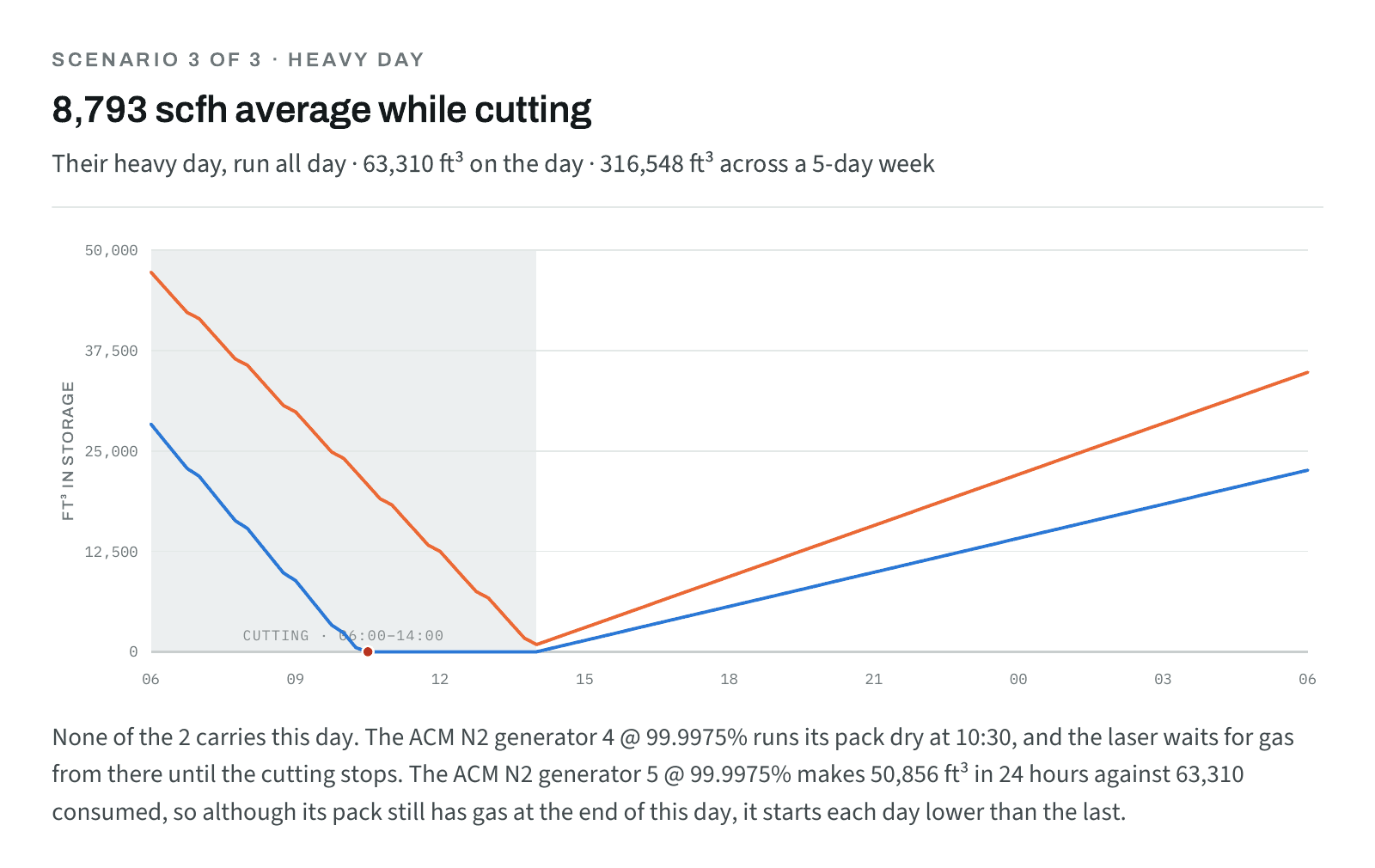
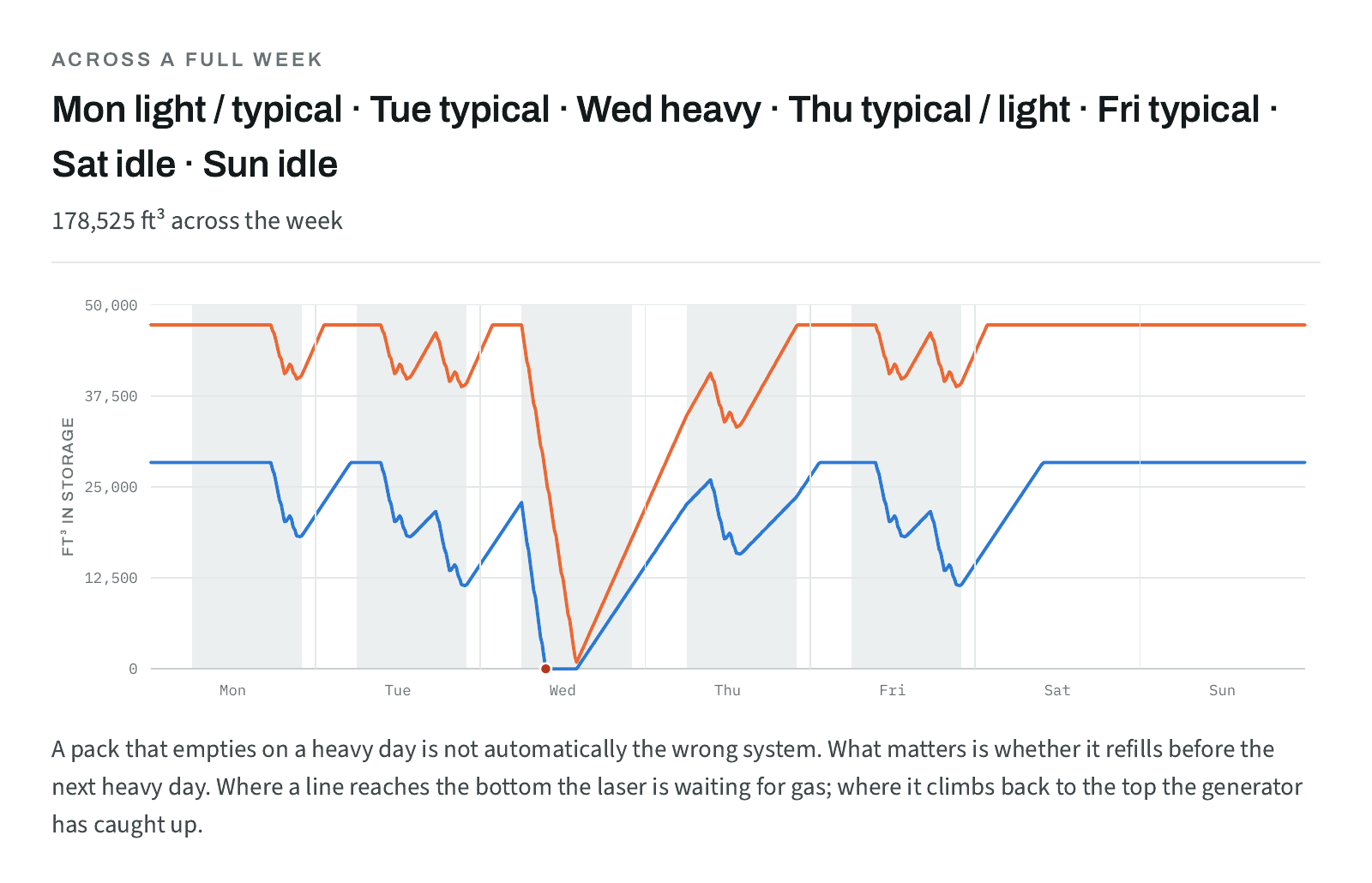
From a sample N2 Flow Bench report, run for an example company.
N2 Generator Styles. On Demand vs Low Flow High Pressure?
| Storage system (low flow, high pressure) | On-demand generator | |
|---|---|---|
| Output | Up to 4,350 psi (300 bar) into high-pressure storage packs | 400 psi (28 bar) direct to the laser |
| How it works | The generator runs until the high pressure storage tanks are full. When cutting draws more than the generator makes, the storage packs make up the difference | Makes nitrogen as the laser calls for it, with no storage buffer |
| Sized on | The day's volume; storage covers the peaks | Worst case peak flow; the generator must meet every spike |
| Suits | Intermittent high flow: fewer than three shifts, or occasional heavy plate on nitrogen | Consistent usage: steady multi-shift work at consistent thicknesses |
What nitrogen purity do you need for laser cutting?
Purity is set by the material and the edge you need, and it should be only as high as the work requires.
| Purity | Use | Result |
|---|---|---|
| 97% | Carbon (mild) steel, any thickness | Higher purity gains nothing on carbon steel. Not suitable for stainless |
| 99.95% | Stainless steel: the minimum | Silver edge up to 3/16 in. (4.8 mm). Above that the edge yellows slightly. It is cosmetic, it does not affect weldability, and most customers accept it |
| 99.9975% or better | Thick stainless that must finish silver | Silver edge at all thicknesses. Needs a larger, more expensive generator |
A generator separates nitrogen from compressed air, and the higher the purity, the less gas the same unit makes. Understanding the purity need matters. A bigger N2 generator is needed to provide the same flow at a higher purity. The reverse also holds: a shop that cuts only carbon steel, at 97%, gets a large volume of nitrogen for a reasonably small N2 generator and a low capital cost. (Mild steel can also be cut on oxygen; how thick a fiber laser cuts mild steel gives the thickness range on oxygen.)
So the useful question is not "what purity do you want". It is "what do you cut, and what is the thickest stainless you run on nitrogen". In a mixed shop, the tightest requirement sets the purity. Aluminum is not covered here, but we include it when a shop cuts it; tell us if you do.
Is a nitrogen generator cheaper than bulk liquid or cylinders?
Per unit of gas, yes, by a wide margin, up to 94% less. These are some industry standard prices in Canadian dollars:
| Nitrogen supply | Per 100 ft³ | Per m³ |
|---|---|---|
| Cylinder packs (16-pack) | $5.32 | $1.88 |
| Bulk liquid | $1.55 | $0.55 |
| On-site generator, before the system's capital cost | $0.32 | $0.11 |
That is roughly 80% less than bulk liquid and 94% less than cylinder packs, before the capital cost. Delivered gas prices vary by supplier, volume and contract, so we use your own invoices wherever you have them.
What decides the purchase is payback. Where payback is under about 3 years, customers generally buy. Over 3 years, shops planning for more volume may still buy. Those savings are lost when an oversized quote makes the system too expensive to buy in the first place.
When a generator will not pay back
Payback does not always work out. Because our estimate starts from your actual usage, we can say so up front rather than after you have bought. Where a generator can pay off, we size the system to your actual usage and volume, and build in future growth, such as another machine, if you want it.
A recent case: three lasers on one system
A customer running a 20 kW and a 6 kW laser with automation was adding a 60 kW laser and looking at nitrogen generators. They were buying about $120,000 of nitrogen a year.
| Annual nitrogen use | Yearly N2 spend estimates from other generator sellers | ACM (N2 Flow Bench) estimates | Actual |
|---|---|---|---|
| Today (20 kW + 6 kW) | Over $300,000 | $110,000 to $140,000 | About $120,000 |
| With the 60 kW added | US$600,000 (one seller) | $250,000 to $300,000 |
Canadian dollars unless marked US$.
Our estimate of their current use matched what they were paying. With the 60 kW built in at the production they expect, projected use came out at less than half of what they had been told. We then worked through generator size and storage for different production scenarios with them and sized the system together.
They bought a system from AC Machinery that feeds all three lasers, and they have the data to adjust production to fit it. They saw no value in a system sized for every laser running flat out, because that is not their production, but it was the only option the other suppliers offered. Having the data and working with Automated Cutting Machinery gave them the confidence to select the right tool for the job.
What a shop needs on site
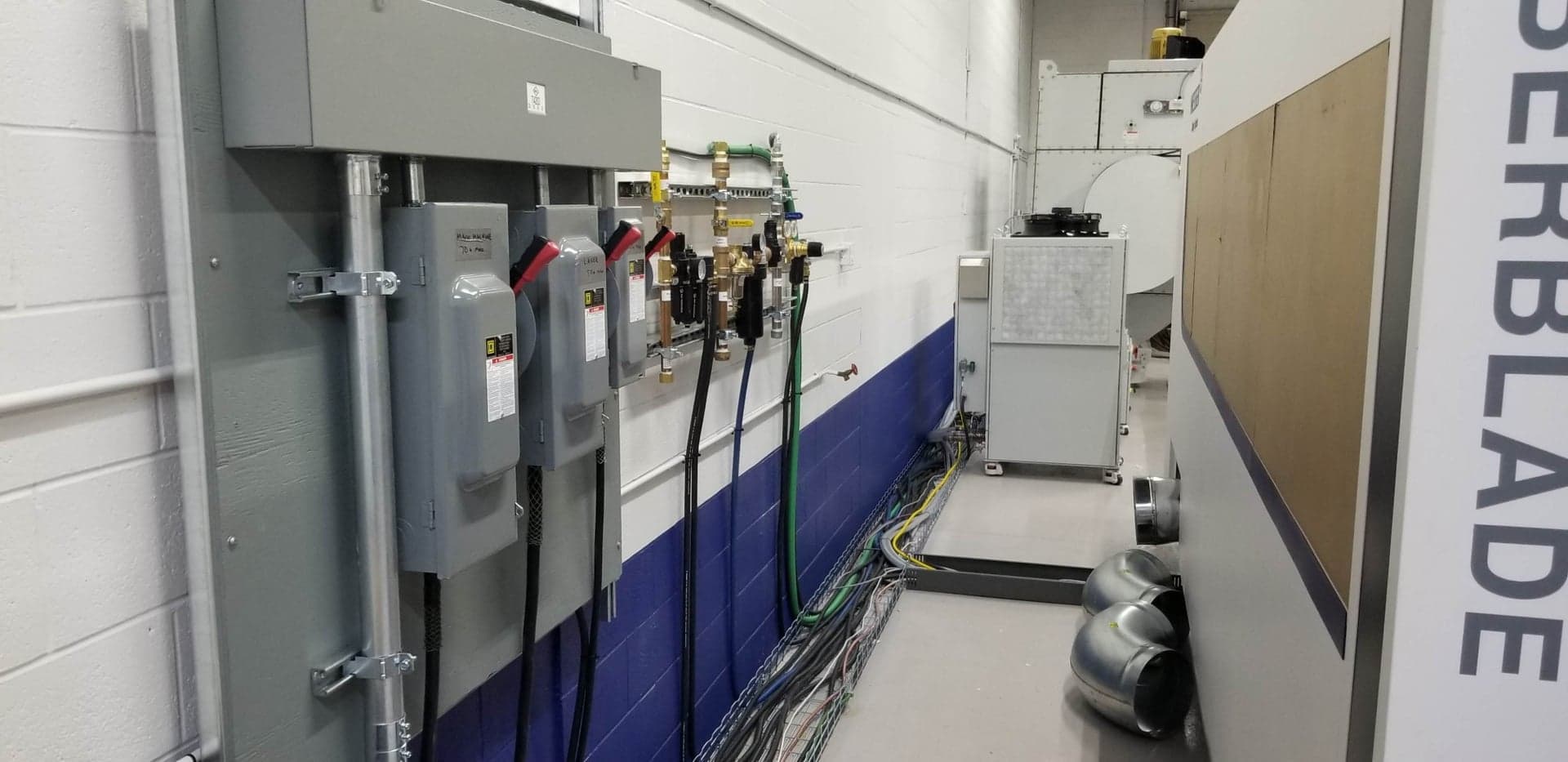
AC Machinery can supply the complete system: compressor, filtration, piping, booster, high-pressure bottle packs, storage racks and installation. If you would rather use your own compressor, for example to stay with your current compressor service company, we work with that.
Systems can go on a mezzanine, inside a sea container, or stacked to reduce floor space. Power and compressed-air requirements depend on the system you choose and are confirmed during sizing.
Send us what you cut
Send us what you cut (materials, thicknesses, lasers, shifts) and what you pay for nitrogen now. We will size a system with you, and show you what changes if your production does.
About Adam Bender
Adam spent roughly twenty years as a field technician servicing plasma and laser cutting machines before taking over AC Machinery. These notes come from that work.
Adam Bender on LinkedInFAQ
Common questions
Short answers to the questions we are asked most about this topic.
Yes. A generator separates nitrogen from compressed air, so it needs a compressor and filtration ahead of it. We can supply the compressor as part of the system, or work with the one you already have and the company that services it.
Often, yes, depending on your production. That is exactly what the sizing study answers, and it will also tell you if the answer is no.
There is no answer from laser power alone. The same laser uses very different amounts of nitrogen on thin mild steel and on thick stainless, and the size also depends on shifts, operating efficiency and how much storage carries the peaks.